KCNA Reliable Test Sample | KCNA Reliable Exam Voucher
Wiki Article
BONUS!!! Download part of Itcertmaster KCNA dumps for free: https://drive.google.com/open?id=16nU55LBqGuLptX8qjwisT2jBBBd83G_-
The simplified information in KCNA certification dumps makes your exam preparation immensely easier for you. All the KCNA exam questions answers are self-explanatory and provide the best relevant and authentic information checked and approved by the industry experts. No key point of the KCNA Exam is left unaddressed. The complex portions have been explained with the help of real life based examples. In case, you don't follow and KCNA dumps, you can contact our customer’s service that is operational 24/7 for your convenience.
Linux Foundation recommends that individuals who are interested in taking the KCNA certification exam have some prior knowledge of Linux and basic cloud computing concepts. However, it is not a requirement, and anyone can take the exam regardless of their background. KCNA exam is designed to be accessible to everyone, and the Linux Foundation provides resources and training materials to help individuals prepare for the exam.
To prepare for the KCNA certification exam, candidates can take advantage of a variety of resources provided by the Linux Foundation. These include online training courses, study guides, and practice exams. Additionally, candidates can participate in community forums and discussion groups to gain insights and advice from other professionals in the field.
Linux Foundation KCNA Certification Exam is recognized globally and is highly valued by organizations that are looking for professionals with expertise in Kubernetes and cloud native technologies. Successful candidates of this certification program are equipped with the skills and knowledge to work in a variety of roles, including cloud administrators, DevOps engineers, and application developers. In the following paragraphs, we will discuss the benefits of the Linux Foundation KCNA Certification Exam and how it can help professionals advance their careers in the field of cloud computing.
>> KCNA Reliable Test Sample <<
KCNA Reliable Exam Voucher, Latest KCNA Dumps Ppt
Related study materials proved that to pass the Linux Foundation KCNA exam certification is very difficult. But do not be afraid, Itcertmaster have many IT experts who have plentiful experience. After years of hard work they have created the most advanced Linux Foundation KCNA Exam Training materials. Itcertmaster have the best resource provided for you to copyright. Does not require much effort, you can get a high score. Choose the Itcertmaster's Linux Foundation KCNA exam training materials for your exam is very helpful.
Linux Foundation Kubernetes and Cloud Native Associate Sample Questions (Q128-Q133):
NEW QUESTION # 128
What is an advantage of using the Gateway API compared to Ingress in Kubernetes?
- A. To expose an application externally by creating only a Service resource.
- B. To provide clearer role separation between infrastructure providers and application developers.
- C. To automatically scale workloads based on CPU and memory utilization.
- D. To configure routing rules through annotations directly on Ingress resources.
Answer: B
Explanation:
The Gateway API is a newer Kubernetes networking API designed to address several limitations of the traditional Ingress resource. One of its most significant advantages is the clear separation of roles and responsibilities between infrastructure providers (such as platform teams or cluster administrators) and application developers. This design principle is a core motivation behind the Gateway API and directly differentiates it from Ingress.
With Ingress, a single resource often combines concerns such as load balancer configuration, TLS settings, routing rules, and application-level details. This frequently leads to heavy reliance on annotations, which are controller-specific, non-standardized, and blur ownership boundaries. Application developers may need elevated permissions to modify Ingress objects, even when changes affect shared infrastructure, creating operational risk.
The Gateway API introduces multiple distinct resources-such as GatewayClass, Gateway, and route resources (e.g., HTTPRoute)-each aligned with a specific role. Infrastructure providers manage GatewayClass and Gateway resources, which define how traffic enters the cluster and what capabilities are available. Application developers interact primarily with route resources to define how traffic is routed to their Services, without needing access to the underlying infrastructure configuration. This separation improves security, governance, and scalability in multi-team environments.
Option A is incorrect because automatic scaling based on CPU and memory is handled by the Horizontal Pod Autoscaler, not by Gateway API or Ingress. Option C describes a characteristic of Ingress, not an advantage of Gateway API; in fact, Gateway API explicitly reduces reliance on annotations by using structured, portable fields. Option D is incorrect because exposing applications externally requires more than just a Service; traffic management resources like Ingress or Gateway are still necessary.
Therefore, the correct and verified answer is Option B, as the Gateway API's role-oriented design is a key advancement over Ingress and is clearly documented in Kubernetes networking architecture guidance.
NEW QUESTION # 129
You need to deploy a pod that requires access to a specific GPU device. How can you ensure that
the pod is scheduled on a node with the required GPU?
- A. Use the 'affinity' field to prefer nodes with the 'GPU* label.
- B. Use the 'podAffinity' field to group pods with GPU requirements together.
- C. Use the 'nodeSelector' field to target nodes with the 'gpu' label.
- D. Use the 'resources' field to specify the GPU requirements in the container's definition.
- E. Use the 'tolerations' field to tolerate the 'GPU' taint.
Answer: D
Explanation:
You can use both the •nodeselector• and •resources' fields to achieve this: 'nodeselector•: Targets nodes with a label indicating the presence of GPUs (e.g., •gpu: true). •resources': Specify the GPU resource requirements within the container's definition. This provides a more precise way to request specific GPUs and their capabilities. While •tolerations' and 'affinity' can be used for other scheduling needs, they are not directly designed for GPU resource allocation.
NEW QUESTION # 130
You're using a cloud provider's managed Kubernetes service with different pricing tiers for nodes. You want to optimize costs by using a mix of node types based on your workload needs. Which of the following is the most appropriate approach?
- A. Use only the most cost-effective node type for all deployments, regardless of their resource requirements.
- B. Utilize node pools with different node types and configure a node selector for deployments to target the appropriate pool.
- C. Manually choose the node type for each deployment based on its resource requirements.
- D. Configure a horizontal pod autoscaler (HPA) to automatically choose the optimal node type based on workload demands.
- E. Use a third-party tool to analyze your cluster's resource utilization and recommend the best node types for each workload.
Answer: B,E
Explanation:
Using a mix of node types based on workload needs is a key cost optimization strategy. Node pools with different node types allow you to run resource-intensive workloads on powerful nodes and less demanding workloads on less expensive nodes. A node selector can be used to target specific pools for deployments. Third-party tools can analyze resource utilization and provide recommendations for node type assignments. Manually choosing node types for each deployment is inefficient and prone to errors. HPA is designed for scaling pods, not choosing node types.
NEW QUESTION # 131
What are the two goals of Cloud-Native?
- A. Rapid innovation and automation
- B. Slow innovation and stable applications
- C. Frequent deployments and well-defined organizational silos
- D. Rapid innovation and reliability
Answer: D
Explanation:
https://www.redhat.com/en/topics/cloud-native-apps
NEW QUESTION # 132
Which of the following is not the Kubernetes AutoScaling Strategy?
- A. Cluster Autoscaler
- B. Vertical Pod Autoscaler
- C. Load Balancing AutoScaler
- D. Horizontal Pod Autoscaler
Answer: C
Explanation:
https://learnk8s.io/kubernetes-autoscaling-strategies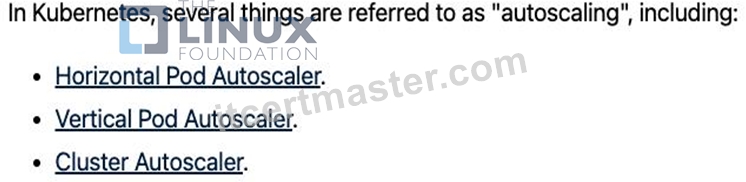
NEW QUESTION # 133
......
Generally speaking, reviewing what you have learned is important, since it will help you have a good command of the knowledge points. KCNA Online test engine has testing history and performance review, so that you can have a general review of what you have learned before next learning. In addition, KCNA exam dumps is convenient and easy to study, it supports all web browsers and Android and iOS etc. You can also practice offline if you like. We provide you with free update for 365 days for KCNA Exam Materials, so that you can get the latest information for the exam timely. And the latest information for KCNA exam dumps will be auto sent to you.
KCNA Reliable Exam Voucher: https://www.itcertmaster.com/KCNA.html
- Test KCNA Testking ???? Pass KCNA Test ???? Latest KCNA Questions ???? Search for ➥ KCNA ???? and obtain a free download on ▶ www.examdiscuss.com ◀ ????KCNA Latest Materials
- KCNA Reliable Test Sample - 2026 Realistic Linux Foundation Kubernetes and Cloud Native Associate Reliable Exam Voucher Pass Guaranteed Quiz ???? Search for { KCNA } and download it for free on 《 www.pdfvce.com 》 website ????Latest KCNA Questions
- Get Valid Linux Foundation KCNA Exam Questions and Answer ???? Easily obtain ➥ KCNA ???? for free download through ⏩ www.dumpsmaterials.com ⏪ ????KCNA Study Dumps
- Test KCNA Testking ???? Exam KCNA Bible ???? Test KCNA Testking ???? Immediately open ▶ www.pdfvce.com ◀ and search for [ KCNA ] to obtain a free download ????Test KCNA Testking
- KCNA Reliable Test Sample - Pass Guaranteed 2026 First-grade KCNA: Kubernetes and Cloud Native Associate Reliable Exam Voucher ???? Search for ▶ KCNA ◀ on ⏩ www.troytecdumps.com ⏪ immediately to obtain a free download ????KCNA PDF Download
- Choose Any Linux Foundation KCNA Exam Dumps Format and Start Preparation ???? Search for ✔ KCNA ️✔️ and obtain a free download on ➽ www.pdfvce.com ???? ????KCNA Reliable Test Review
- www.validtorrent.com Enables You to Succeed on The KCNA Exam the First Time ???? Simply search for ▶ KCNA ◀ for free download on “ www.validtorrent.com ” ????PDF KCNA Cram Exam
- Pdfvce Enables You to Succeed on The KCNA Exam the First Time ???? Go to website ( www.pdfvce.com ) open and search for ➥ KCNA ???? to download for free ????Valid KCNA Exam Tips
- Valid Dumps KCNA Ebook ???? KCNA PDF Download ❎ Valuable KCNA Feedback ???? Immediately open ☀ www.practicevce.com ️☀️ and search for ⮆ KCNA ⮄ to obtain a free download ????KCNA Latest Materials
- Take Your Linux Foundation KCNA Exam with Preparation Material Available in Three Formats ???? Go to website ➽ www.pdfvce.com ???? open and search for “ KCNA ” to download for free ????Test KCNA Testking
- KCNA PDF Download ???? Test KCNA Testking ???? KCNA Latest Study Materials ???? Search for ✔ KCNA ️✔️ and obtain a free download on ➡ www.vceengine.com ️⬅️ ????Test KCNA Testking
- ihannafznr679136.p2blogs.com, my-social-box.com, declanjtxs735508.blog-ezine.com, kiararmrk585788.blog-a-story.com, brianqtvw197134.blogchaat.com, aliviaejmw980306.national-wiki.com, marleyzytm404965.wikiannouncement.com, kaitlynjzrs324978.myparisblog.com, finniangbgx030837.blogginaway.com, webdirectory11.com, Disposable vapes
P.S. Free 2026 Linux Foundation KCNA dumps are available on Google Drive shared by Itcertmaster: https://drive.google.com/open?id=16nU55LBqGuLptX8qjwisT2jBBBd83G_-
Report this wiki page